Retinol vs Retinal: What’s the Difference and Which Should You Use?
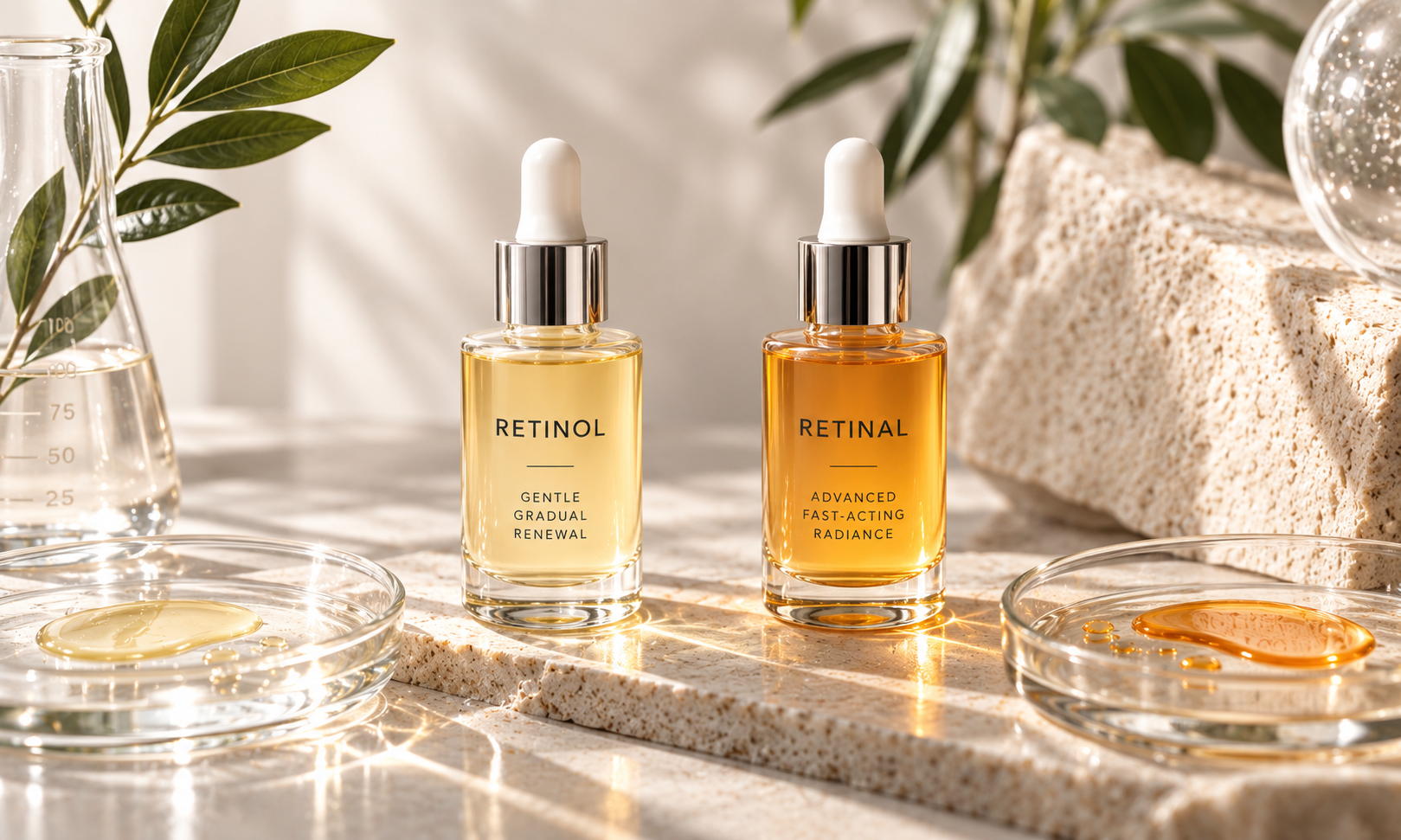
Retinol has been an anti-ageing skincare favourite for years. Then retinal started appearing. At first glance, it sounds suspiciously like somebody forgot the last letter of retinol, but retinol and retinal are actually two different forms of vitamin A - and that small change in spelling makes a meaningful difference to how they behave in your skin.
You’ll often hear retinal described as “stronger”, “faster” or “better than retinol”. There’s some truth hiding in there, along with quite a bit of skincare marketing. So, retinol vs retinal: which one should you use? The short version: both are retinoids used to target visible signs of skin ageing, including fine lines, uneven texture, and pigmentation. Retinal - also called retinaldehyde - is one conversion step closer to retinoic acid, the biologically active form used by the skin, while retinol requires two conversion steps.

That can make retinal an interesting option when you want more activity from an over-the-counter retinoid. However, if you’ve never used a retinoid before, have easily irritated skin or already have a retinol product your skin loves, there’s no reason to feel that you’ve suddenly fallen behind.
“Retinoid” is the family name for vitamin A and its derivatives, which include retinyl esters, retinol, retinal or retinaldehyde, and retinoic acid, including tretinoin. They’re related, but they aren’t identical. Topical retinoids have been extensively studied for photoageing and can influence processes involved in epidermal turnover and collagen, which is why they’ve become such an established part of anti-ageing skincare. The confusion starts because your skin ultimately needs the active retinoic acid form for retinoid activity, and different cosmetic retinoids take different routes to get there. That’s the key to understanding retinal versus retinol.

Think of the conversion pathway as a short journey: retinol → retinal → retinoic acid. Retinol converts to retinal, which then converts to retinoic acid. When you apply retinol, it takes two conversion steps to reach retinoic acid; when you apply retinal, it takes only one. That’s why retinal is often described as more direct or potentially more potent than retinol. However, skincare marketing often sprints ahead of the science.
Retinol is a vitamin A derivative used extensively in cosmetic skincare and is commonly found in anti-ageing serums, night creams, eye creams and facial treatments. With consistent use, it can help improve the appearance of fine lines and wrinkles, uneven skin texture, dullness, uneven-looking pigmentation and photoaged skin. It isn’t an overnight ingredient. You use it for four nights, inspect your forehead under extremely unflattering bathroom lighting and wonder why you don’t suddenly look ten years younger. Retinoids don’t work like that. Consistency matters far more than drama.
Retinal is short for retinaldehyde. Like retinol, it’s a vitamin A derivative, but it sits one step closer to retinoic acid in the conversion pathway. Because retinal doesn’t require the initial conversion that retinol does, it has become an increasingly interesting ingredient in modern anti-ageing skincare. It potentially offers a more direct route to retinoid activity while still being used in cosmetic formulations, and you’ll increasingly find it in anti-ageing serums, night treatments, eye products and advanced retinoid creams. For years, retinol dominated the cosmetic conversation. Retinal is now very much having its moment.
Generally, retinal is considered more potent than retinol because it requires one fewer metabolic conversion before becoming retinoic acid. However, “stronger” can be a dangerous word in skincare because it encourages the assumption that stronger is always better. Your skin doesn’t necessarily agree.
A retinoid product's performance also depends on its concentration, formulation, stability, delivery system, frequency of use, your individual skin, and the other products in your routine. A beautifully formulated retinol product that you can use consistently may give you far more value than an aggressive retinal formula that leaves your skin so irritated you stop using it after two weeks. The ingredient matters, but the formula matters too.
Retinal may work faster than retinol because it requires fewer conversion steps, giving it a reasonable biological basis for greater activity at suitable concentrations. However, be cautious when you see precise claims such as “retinal works 11 times faster than retinol”. That number is repeated constantly online as though it were a universal law of skincare, but it isn’t. Different products use different concentrations, stabilisation technologies and delivery systems, and human skin varies enormously. It’s more useful to say that retinal has a shorter conversion pathway and may provide effective retinoid activity at lower concentrations than retinol. That may be a less exciting headline, but it’s much more useful information.

If your main concern is fine lines and wrinkles, both ingredients can make sense. Retinoids are among the better-established topical ingredients used for photoaged skin, and they can influence collagen-related processes and epidermal turnover, helping improve the appearance of fine lines and skin texture over time. Retinal’s more direct conversion pathway makes it particularly interesting for people who already understand retinoids and want to explore a different cosmetic vitamin A option. However, don’t take that to mean retinol no longer works because retinal exists. It does. If you’re happily using retinol and seeing results, there’s no skincare emergency requiring you to switch.
Both retinol and retinal can also help improve rough or uneven-looking texture by influencing the way skin cells develop and turn over. This is one of those changes that can sneak up on you. You may not wake up one morning thinking, “Good heavens, my epidermal turnover has improved.” You simply notice that your skin looks smoother, makeup sits better, the surface looks more refined, and your complexion appears healthier. That’s usually a better way to judge skincare anyway.
Retinoids can be part of a routine that targets uneven-looking pigmentation and sun-damaged skin. By influencing skin-cell turnover, they can help improve the appearance of uneven tone over time. However, if pigmentation is your main concern, don’t make the classic mistake of focusing entirely on the treatment product while ignoring sunscreen. Trying to correct sun-related pigmentation without protecting your skin from further UV exposure is a bit like mopping the floor while the tap is still running. Your morning sunscreen matters a lot, especially in Australia.
There’s no universal winner for mature skin. If your skin is already comfortable with retinol, you may have no reason to change. If you’re looking for a more advanced retinoid option, retinal may be worth considering. Mature skin can also become drier, which means your entire routine matters. You could have the world’s most exciting retinal serum, but if you’re combining it with an aggressive cleanser, too much exfoliation and no decent moisturiser, your skin probably isn’t going to thank you. For mature skin, think about the whole picture: retinoid + hydration + moisturiser + sun protection, rather than retinoid + more retinoid + strongest possible retinoid.
For beginners, retinol still makes sense. If you’ve never used a retinoid, you don’t necessarily need to begin with the most active option you can find. A well-formulated, lower-strength retinol product introduced gradually can be an excellent starting point, giving you an opportunity to see how your skin responds to vitamin A skincare. Once you know your skin tolerates retinoids well, you can decide whether moving to retinal makes sense, or you may decide that your retinol is doing exactly what you want. That’s also a successful outcome. Skincare doesn’t have levels you need to unlock.
Whether retinal is better for sensitive skin is more complicated. You might assume that the more potent ingredient must automatically be more irritating, but that isn’t necessarily the case. Some retinal formulations are designed to deliver effective retinoid activity while remaining well tolerated. However, retinal is still a retinoid and can cause dryness, flaking, redness, tightness, stinging and irritation, particularly when first introduced or used too frequently. If your skin is sensitive, the formulation and concentration matter even more. Don’t choose a retinoid based purely on whether the bottle says retinal or retinol; look at the whole product.
Both retinol and retinal can cause what people often call the retinisation period when you first introduce them. Your skin may become drier than usual, slightly flaky, more sensitive, red or irritated. Some mild adjustment can happen, but there’s an important distinction between adjustment and damaging your skin barrier. If your face is burning, intensely red, painful, cracking or persistently peeling, don’t congratulate yourself because the retinoid is “working”. Back off. Skincare doesn’t become more effective because it hurts.
Introducing retinol or retinal doesn’t need to be complicated. Start slowly rather than using your new retinoid every night right away. Follow the product instructions and your skin’s tolerance; for many people, that might mean starting a couple of evenings per week. Use a small amount, because more product doesn’t mean faster results. Apply it at night, moisturise regularly and wear sunscreen during the day. Daily sun protection is essential if you’re serious about addressing visible photoageing.
A simple retinoid night routine might include a gentle cleanser, followed by your retinol or retinal product and then moisturiser. If your skin is particularly dry or sensitive, some people prefer the so-called moisturiser sandwich: moisturiser → retinoid → moisturiser. Applying moisturiser first can reduce retinoid intensity for some users. You may sacrifice a little directness of application, but if it helps you use the product comfortably and consistently, that’s a perfectly reasonable trade-off.
For most people using cosmetic skincare at home, there’s very little reason to layer a separate retinol and retinal product together. They both deliver vitamin A-related activity, and using both doesn’t automatically double your anti-ageing results. It may simply double your chances of irritation. Choose one, give it time and see what happens. Your face isn’t a laboratory bench.
Peptides and retinoids can generally fit comfortably within the same skincare routine. It’s a sensible pairing: retinoids provide targeted vitamin A treatment, while peptides can complement an anti-ageing routine focused on smoother, firmer and healthier-looking skin. You might use a peptide serum followed by moisturiser and sunscreen in the morning, then retinol or retinal followed by moisturiser in the evening. Alternatively, use a moisturiser that already contains supportive ingredients. There’s no need to create an unnecessarily complicated schedule.
Hyaluronic acid is also easy to incorporate. It’s a humectant used primarily to support hydration, which can be particularly useful when you’re using a retinoid that has the potential to make your skin feel dry. Depending on the formulations and instructions, a routine might look like cleanser → hydrating serum → retinoid → moisturiser. Retinoid nights don’t need to be deliberately drying; quite the opposite.
You can potentially use vitamin C with retinol or retinal, but if your skin is easily irritated, separating them may make your routine simpler. For example, use vitamin C followed by moisturiser and sunscreen in the morning, then retinol or retinal followed by moisturiser in the evening. That isn’t because vitamin C and retinoids are sworn enemies. It’s simply a practical way to distribute active ingredients across your routine. Sometimes skincare advice becomes complicated because we’re trying to solve problems that don’t actually exist.
Exfoliating acids require more caution. If you’re using glycolic acid, lactic acid, salicylic acid or other exfoliating treatments, adding them aggressively alongside a new retinoid can create irritation. You may tolerate both perfectly well, but you may not. If you’re new to retinoids, introduce the retinoid first and understand how your skin responds before adding more actives. You might use a retinoid on Monday, simple hydration on Tuesday, a retinoid on Wednesday and simple hydration on Thursday. You don’t need to turn your skincare routine into an active-ingredient obstacle course.

You can’t compare retinol and retinal percentages directly. You can’t look at the percentage printed on a retinol bottle and the percentage on a retinal bottle and assume that the larger number is stronger. For example, seeing 0.1% retinal next to 0.3% retinol doesn’t automatically mean the retinol product is stronger because 0.3 is a bigger number. They’re different molecules with different conversion pathways, and formulation also changes how they’re delivered. Don’t shop by percentage alone. Consider which retinoid is being used, its concentration, the product instructions, delivery technology, other ingredients and the intended experience level. Preferably, buy from a brand that clearly explains how the product is formulated.
Retinoids aren’t always the easiest cosmetic ingredients to work with. Retinal, in particular, can be chemically unstable and sensitive to environmental conditions. That’s why modern retinal products often mention encapsulation, stabilisation, controlled delivery, airless packaging and light-protective packaging. This isn’t necessarily marketing fluff. A fantastic active ingredient isn’t particularly useful if it degrades before it reaches your face. Packaging matters more than people sometimes realise. That cute transparent jar sitting in direct sunlight on your bathroom windowsill may not be the ideal home for every retinoid.
As for how long retinol or retinal takes to work, the answer is simple: give it time. Changes in hydration can happen relatively quickly when the overall formulation contains moisturising ingredients, but changes associated with fine lines, texture and pigmentation take longer. Think in terms of weeks and months, not days. Take a photograph before starting, use the same lighting and compare later. When you stare at your face every morning, gradual improvement can be surprisingly difficult to notice.
Before switching from retinol to retinal, ask yourself why. If your answer is, “My retinol isn’t giving me enough improvement after consistent use, my skin tolerates retinoids well and I’d like to explore a different option,” retinal may be worth trying. If your answer is, “TikTok told me retinol is old now,” keep your retinol. A skincare ingredient doesn’t stop working because another ingredient becomes fashionable.
Retinol may be the better choice if you’re completely new to retinoids, want a gradual introduction to vitamin A skincare, have found a retinol formula your skin tolerates beautifully, are already seeing the results you want, have easily irritated skin or prefer the wider choice of established retinol products available. There is nothing second-rate about using retinol.
Retinal may be worth exploring if you’ve already used retinol successfully, are looking for a more direct cosmetic retinoid, have fine lines and visible photoageing as major concerns, want to explore newer-generation vitamin A formulations or have found a retinal product with good stabilisation and delivery technology. You should still be prepared to introduce it gradually. Again, the product matters as much as the ingredient.
You also don’t have to use a retinoid. If your skin simply doesn’t tolerate retinol or retinal, there are other ingredients worth exploring, including peptides, vitamin C, niacinamide, hyaluronic acid, ceramides, antioxidants, nourishing facial oils and mineral-rich moisturisers. And sunscreen—always sunscreen. At Jericho Skincare Australia, you’ll find anti-ageing skincare built around a wide range of ingredients, from peptides, hyaluronic acid and antioxidants to botanical extracts and Dead Sea mineral complexes, so retinoids don’t have to be the only route to caring for mature or ageing skin.
Dead Sea minerals and retinoids don’t need to compete because they serve different purposes. A retinoid is your targeted active, while a well-formulated Dead Sea mineral moisturiser can provide the hydrating, nourishing support that becomes especially important when using ingredients such as retinol or retinal. A simple evening routine could be gentle cleanser → retinol or retinal → hydrating Dead Sea mineral moisturiser. If your skin feels dry, add a hydrating serum. If it doesn’t, don’t add one simply because somebody’s skincare chart says you should.
Retinol vs Retinal: Quick Comparison
| Retinol | Retinal |
|---|---|
| Vitamin A derivative | Vitamin A derivative |
| Also called retinol | Also called retinaldehyde |
| Requires two conversion steps to retinoic acid | Requires one conversion step to retinoic acid |
| Used for fine lines, wrinkles, texture and uneven tone | Used for fine lines, wrinkles, texture and uneven tone |
| Well established in cosmetic skincare | Growing evidence and increasing cosmetic use |
| Can cause irritation | Can cause irritation |
| Often a sensible starting option for beginners | Depends on the formula and skin tolerance |
| Usually used in the evening | Usually used in the evening |
| Can be used with peptides | Can be used with peptides |
| Usually unnecessary to use alongside retinal | Usually unnecessary to use alongside retinol |
Frequently Asked Questions
Is retinal the same as retinol? No. Both are vitamin A derivatives, but retinal—also called retinaldehyde—is one metabolic conversion step closer to retinoic acid than retinol.
Is retinal stronger than retinol? Retinal has a more direct conversion pathway to retinoic acid and can provide significant activity at relatively low concentrations. However, the strength and effectiveness of a finished product also depend on concentration, formulation, stability and delivery.
Is retinal better than retinol for wrinkles? Not automatically. Both can be useful for visible signs of photoageing. Retinol has a long history in cosmetic skincare, while retinal offers a more direct conversion pathway. The better choice is the one your skin tolerates and you can use consistently.
Should beginners use retinol or retinal? A gentle retinol formula can be a sensible starting point for someone completely new to retinoids. However, modern retinal formulations vary considerably, so some may also be designed for beginners.
Can retinal cause purging? Retinoids can alter skin-cell turnover, and some people may notice temporary changes when introducing them. Persistent or severe breakouts shouldn’t automatically be dismissed as “purging”.
Can I use retinal every night? Some experienced users may eventually tolerate nightly application, depending on the product. Follow the manufacturer’s directions and build frequency according to your skin’s response.
Can I use retinal around my eyes? Only use a product around the eye area if it’s formulated and directed for use there. The eye area can be particularly sensitive.
Can I use retinol and retinal on alternate nights? You could, but for most people there’s little reason to own two separate retinoids. Using one consistently makes it much easier to judge results and tolerance.
Can I use peptides with retinal? Yes, depending on the individual formulas. Peptides can complement a retinoid-based anti-ageing routine and are commonly used alongside hydrating and moisturising ingredients.
Do I need sunscreen when using retinol or retinal? Daily sun protection is important in any anti-ageing skincare routine, particularly when you’re trying to improve signs associated with photoageing and uneven pigmentation.
Is retinal worth switching to if my retinol works? Not necessarily. If your current retinol is comfortable and delivering the results you want, there’s no compelling reason to switch simply because retinal is newer.
So, Retinol or Retinal?
If you came here hoping I’d declare one the winner, skincare is rarely that cooperative. Retinal has an advantage on paper because it’s one conversion step closer to retinoic acid. That’s interesting and it matters, but it doesn’t suddenly make retinol obsolete. If you’re new to vitamin A skincare, a gentle retinol product may be a perfectly sensible place to start. If you’ve used retinol for some time, tolerate it well and want to explore a more direct cosmetic retinoid, retinal becomes very interesting. And if your current retinol is working, keep using it. The best anti-ageing ingredient isn’t necessarily the newest one, the strongest one or the one everybody is talking about this month. It’s the one that works for your skin, fits comfortably into your routine and that you’ll actually keep using. Consistency is considerably less glamorous than hype. It also tends to be much more useful.