Dead Sea Minerals for Skin: Benefits, Application & What the Science Says
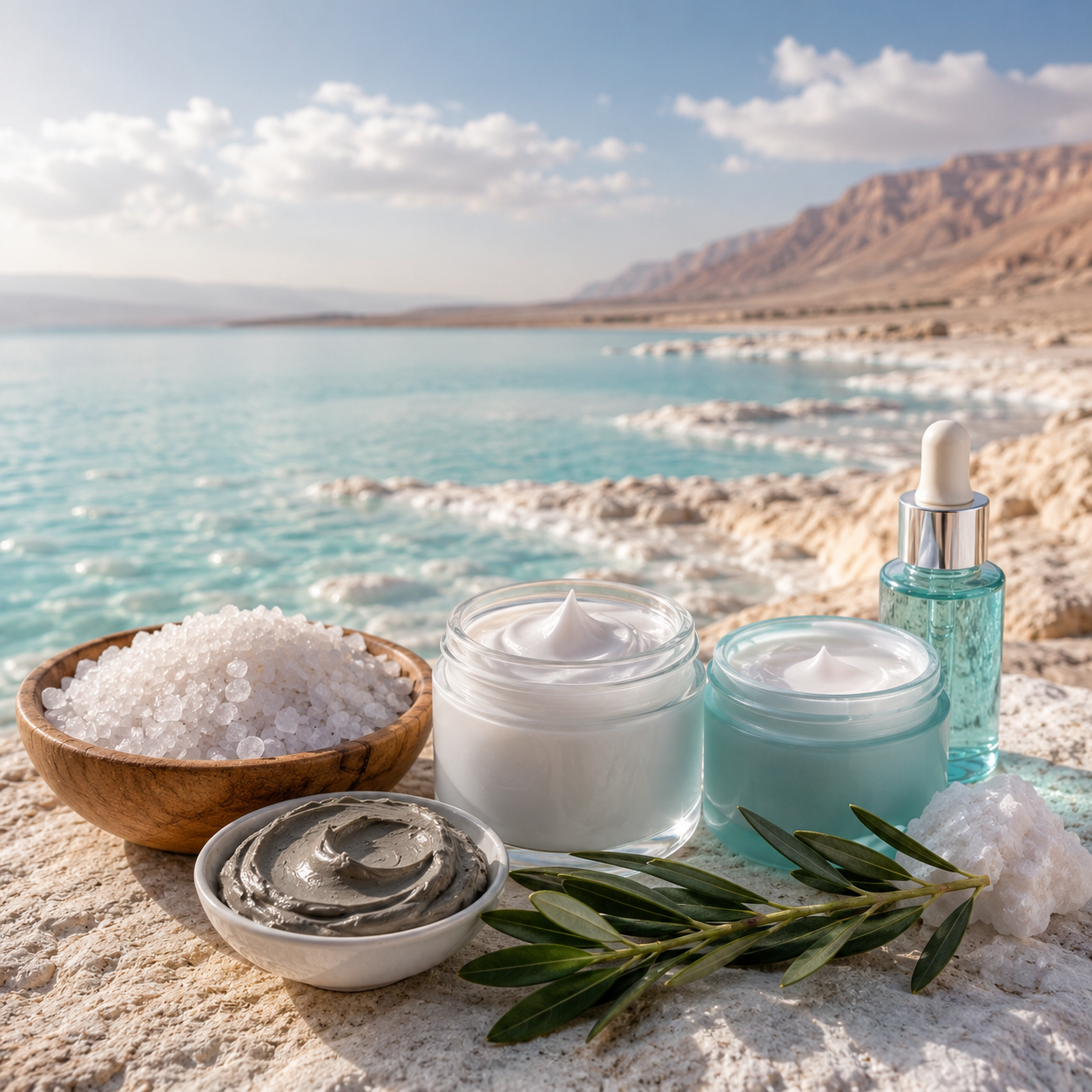
For thousands of years, people have travelled to the Dead Sea to float in its famously salty water, cover themselves in mineral-rich mud and enjoy one of the world's most unusual natural spa experiences. But take away the beautiful scenery and centuries of tradition and there's an obvious question:
Are Dead Sea minerals actually good for your skin—or is it mostly clever skincare marketing?
There is genuine scientific interest behind Dead Sea minerals. Research has investigated mineral-rich Dead Sea salt solutions for skin hydration, barrier function, roughness and inflammation, although that doesn't mean every Dead Sea skincare product will produce the same results.
So, let's separate the skincare facts from the hype.
What Are Dead Sea Minerals?
The Dead Sea is famous for its extremely mineral-rich, salty water. Unlike ordinary seawater, its mineral composition includes particularly high concentrations of salts containing magnesium, alongside minerals such as:

- Magnesium
- Calcium
- Potassium
- Sodium
- Bromide and other mineral salts
Magnesium receives a lot of attention in skincare research because of its potential relationship with the skin barrier, hydration and inflammatory processes. Research literature describes magnesium as a particularly abundant component of Dead Sea water.
But here's something important to understand.
Dead Sea minerals aren't one magical ingredient.
They're a naturally occurring mixture of mineral salts, and the benefits of a finished skincare product also depend on its complete formulation. A beautifully formulated moisturiser containing Dead Sea minerals, for example, is very different from simply rubbing salt onto your face.
What Are the Benefits of Dead Sea Minerals for Skin?
You'll see some enormous claims online about Dead Sea minerals. Some are reasonable. Others deserve a large pinch of salt—no pun intended.
Based on available research, the most interesting potential benefits centre around hydration, skin-barrier support, skin comfort and the appearance and feel of rough, dry skin. Let's look at them individually.
1. Dead Sea Minerals May Help Support Skin Hydration
This is one of the most interesting areas of research.
In a clinical study published in the International Journal of Dermatology, people with atopic dry skin soaked one forearm in a solution containing 5% Dead Sea salt for 15 minutes, while the other forearm was exposed to tap water. After repeated treatment, researchers reported improved skin hydration in the Dead Sea salt-treated skin. Why might that happen?
Magnesium salts can interact with water, and the researchers suggested that the high magnesium content of the salt solution was likely involved in the observed effects. That doesn't mean Dead Sea salt should replace your moisturiser. Think of mineral skincare as one part of a good hydration routine, rather than the entire routine.
2. They May Help Support the Skin Barrier
Your skin barrier is essentially your body's protective outer shield. It helps keep moisture in while protecting you from the outside environment. When the barrier isn't functioning properly, skin can become:
- Dry
- Tight
- Flaky
- Rough
- Sensitive
- Easily irritated
The same Dead Sea salt study found improved barrier function in participants who began with elevated transepidermal water loss—a measurement commonly used to evaluate how effectively the skin retains water.
Laboratory research has also explored how Dead Sea water may influence proteins associated with epidermal barrier function. One study using skin models reported increased expression of barrier-related proteins including filaggrin and involucrin, although laboratory findings shouldn't automatically be treated as proof of the same effect in everyday cosmetic use.
This distinction matters. There's promising science here, but skincare isn't magic.
3. Dead Sea Salt May Help Dry, Rough-Feeling Skin
If your skin feels like sandpaper, your first instinct might be to scrub harder. That's not always the best idea.
In the clinical study discussed above, researchers found that bathing with the magnesium-rich Dead Sea salt solution reduced measured skin roughness compared with the control treatment. That makes mineral bathing particularly interesting for body care.
A mineral salt bath followed by a nourishing body moisturiser, for example, can become a simple ritual for skin that feels dry or rough. The key word is gentle. Scrubbing dry skin aggressively isn't the same thing as caring for it.
4. Dead Sea Minerals Have Been Studied for Skin Inflammation
This is where we need to be especially careful with skincare claims. Research has investigated Dead Sea treatments in people with inflammatory skin conditions, including psoriasis and atopic dry skin. A systematic review found evidence supporting Dead Sea treatments for psoriasis, while noting that Dead Sea therapy involves more than minerals alone—including the region's distinctive climate and UV exposure.
The magnesium-rich salt bathing study also reported reduced redness, which the researchers used as a marker of inflammation. That's interesting scientifically. But a cosmetic product containing Dead Sea minerals should not automatically be treated as a medical treatment for eczema, psoriasis or another skin disease. If you have an ongoing skin condition, follow advice from your dermatologist or healthcare professional.
5. Dead Sea Minerals Can Be Part of a Relaxing Body-Care Ritual
Not every skincare benefit needs to happen inside a laboratory. There's also something wonderfully simple about soaking in a warm mineral bath after a long day. Dead Sea bath salts can turn an ordinary bath into more of a spa-like ritual, while mineral body products can make caring for dry-feeling skin feel less like a chore. And sometimes that matters.
A skincare routine only works if you actually enjoy using it consistently.
Dead Sea Salt vs Dead Sea Mud: What's the Difference?
These two ingredients are closely associated with the Dead Sea, but they're not interchangeable.
Dead Sea Salt
Dead Sea salt is best known for its concentrated mineral content and is commonly used in:
- Bath salts
- Body soaks
- Foot treatments
- Body-care products
It's particularly suited to a mineral bathing experience.

Dead Sea Mud
Dead Sea mud combines minerals with the physical properties of natural mud and is commonly found in:
- Face masks
- Body masks
- Cleansing treatments
- Spa treatments
Mud masks are generally used as rinse-off treatments, particularly when the goal is to cleanse the skin and leave it feeling refreshed and smooth.
So which one should you choose? You don't necessarily have to. Salt is ideal for soaking. Mud is ideal for masking. And mineral-enriched creams, serums and cleansers can bring the Dead Sea concept into your everyday routine.
Can You Put Dead Sea Salt Directly on Your Face?
This is where enthusiasm can go a little too far. Just because something comes from nature doesn't mean you should apply it directly to your face. Highly concentrated salt can be irritating, particularly if your skin is already:
- Sensitive
- Inflamed
- Cracked
- Over-exfoliated
- Recently shaved
- Experiencing barrier damage
Instead, choose a properly formulated skincare product and follow its directions. More minerals don't automatically equal better results.
Are Dead Sea Minerals Good for Dry Skin?
They can be incorporated into a routine for dry skin, particularly when the complete product is designed to moisturise and support comfortable-feeling skin. But pay attention to the whole ingredient list. For dry skin, you may also want ingredients such as:
- Glycerin
- Hyaluronic acid
- Ceramides
- Squalane
- Nourishing plant oils
- Shea butter
Dead Sea minerals can complement these ingredients rather than replacing them. And if your skin is persistently dry, flaky or uncomfortable, don't simply keep adding more products. Sometimes a compromised skin barrier needs a simpler routine, not a bigger one.
Are Dead Sea Minerals Good for Oily Skin?
Dead Sea mud products are particularly popular among people with oily or combination skin because rinse-off mud masks can leave skin feeling deeply cleansed and refreshed. But oily skin still needs moisture. That's an important point.
A common skincare mistake is:
Oily skin → aggressive cleansing → skin feels stripped → even more aggressive cleansing.
Your face shouldn't feel painfully tight after cleansing or masking. Choose products appropriate for your skin type and follow a mud mask with suitable hydration when needed.
What About Sensitive Skin?
Sensitive skin requires a little more caution. Some people may enjoy mineral skincare without any problem, while others may find certain salt-rich, fragranced or intensive products uncomfortable.
If you have sensitive skin: Patch test first.
Introduce one new product at a time. Don't combine several strong treatments at once. And if something burns or causes persistent irritation, wash it off and stop using it. Skincare isn't supposed to be an endurance test.
Dead Sea Minerals vs Regular Sea Minerals
So why not just use ordinary sea salt? The attraction of Dead Sea minerals lies partly in their distinctive mineral composition, particularly their magnesium-rich character. Research literature examining Dead Sea bathing has focused specifically on this mineral profile rather than treating all salt water as identical.
That doesn't mean ordinary seawater is "bad" and Dead Sea water is "good." They're simply different mineral environments. For skincare shoppers, the more useful question is: How has the manufacturer incorporated those minerals into the finished product?
Formulation matters enormously.
Can Minerals Really Penetrate the Skin?
This topic gets complicated very quickly. You'll sometimes see claims suggesting that bathing in minerals allows your body to absorb large quantities of magnesium through the skin.
The evidence isn't nearly that straightforward. Your skin is specifically designed to act as a barrier, and reviews of transdermal magnesium have highlighted limitations in evidence supporting substantial magnesium absorption through normal skin.
Older research has detected penetration of certain mineral components under particular bathing conditions, but that shouldn't be interpreted as proof that every Dead Sea cream or bath provides meaningful whole-body mineral supplementation.
So if you're using Dead Sea skincare, use it for skincare. Don't treat your face cream as a magnesium supplement.
How to Use Dead Sea Minerals in Your Skincare Routine
You don't need to cover yourself head-to-toe in mud every morning. Dead Sea minerals can fit into a surprisingly normal routine.
For Your Face:
Morning: Gentle cleanser → serum → moisturiser → broad-spectrum sunscreen
Evening: Cleanser → Dead Sea mineral serum or treatment → moisturiser
Then add a mineral or mud mask when appropriate for your skin type.
For Your Body:
Try: Mineral bath or shower → gentle body exfoliation when needed → rinse → body moisturiser
Applying body cream after bathing can help keep freshly washed skin feeling soft and comfortable.
For an At-Home Spa Day
This is where Dead Sea skincare becomes particularly enjoyable.
Run a bath. Add Dead Sea bath salts according to the product directions. Apply a suitable facial mask. Relax. Rinse. Finish with facial and body moisturiser.
Suddenly your bathroom is doing a respectable impression of a spa.
How Often Should You Use Dead Sea Products?
It depends entirely on the product. A moisturiser may be formulated for daily use. A cleanser might be used once or twice daily. A mud mask might only be recommended once or several times per week. Bath salts are different again.
Always follow the directions on the individual product rather than assuming all Dead Sea skincare should be used at the same frequency.
And pay attention to your skin. If it feels comfortable, hydrated and balanced, great. If it becomes tight, red or irritated, reduce the intensity of your routine.
How to Choose a Good Dead Sea Skincare Product
The words "Dead Sea Minerals" on the front of a jar aren't enough. Turn the product around. Look at the entire formulation and think about what you're actually trying to achieve.
If your skin is dry:
Look for mineral products combined with moisturising and emollient ingredients.
If your skin is oily:
Consider gentle cleansers and appropriately formulated mud or mineral masks without stripping your skin.
If your skin looks dull:
Look for a routine combining gentle cleansing, hydration and occasional exfoliation rather than trying to scrub your way to brightness.
If your skin is mature:
Consider mineral skincare alongside ingredients targeting hydration and the appearance of fine lines and elasticity.
If your skin is sensitive:
Keep the routine simple and patch test before committing to regular use.
Your skin concern should choose the product—not the trend.
What Does the Science Actually Say?
Here's the short version. There is legitimate research behind Dead Sea mineral treatments.
Clinical research has found that bathing in a magnesium-rich Dead Sea salt solution can improve hydration and, in certain participants, measures of skin-barrier function, while reducing roughness and redness.
Laboratory research has also reported effects on biological markers related to barrier function and inflammation, although those findings don't automatically translate into identical results from every cosmetic product containing Dead Sea ingredients.
Dead Sea treatments have also been studied in dermatology, particularly for psoriasis, but traditional Dead Sea therapy can combine mineral bathing, climate and controlled sun exposure, making it inappropriate to attribute every observed medical benefit to the minerals alone.
That's a much more interesting story than simply saying: "Dead Sea minerals are miraculous." They're not magic. But they're certainly more than just a beauty trend.
Frequently Asked Questions About Dead Sea Minerals
What do Dead Sea minerals do for your skin?
Research suggests magnesium-rich Dead Sea salt bathing may help support skin hydration, barrier function and smoother-feeling skin. The results you experience from a cosmetic product will also depend on its complete formulation.
What minerals are found in the Dead Sea?
Dead Sea water contains mineral salts including magnesium, calcium, potassium, sodium and bromide. Its mineral balance differs considerably from ordinary seawater, with magnesium being particularly prominent in research into its skin effects.
Are Dead Sea minerals good for your face?
Dead Sea minerals can be included in facial cleansers, masks, creams and serums. Choose a properly formulated product designed for facial use rather than applying highly concentrated raw salts directly to your face.
Can I use Dead Sea skincare every day?
Some products are designed for daily use, while masks, exfoliants and intensive treatments may be intended for occasional use. Always follow the individual product instructions.
Is Dead Sea mud the same as Dead Sea salt?
No. Both contain minerals associated with the Dead Sea, but salt is commonly used for bathing and soaking while mud is particularly popular in rinse-off facial and body masks.
Do Dead Sea minerals cure eczema or psoriasis?
Dead Sea treatments have been studied for inflammatory skin conditions, particularly psoriasis, but cosmetic Dead Sea skincare should not be presented as a cure or replacement for medical treatment.
Is Dead Sea skincare suitable for men?
Absolutely. Minerals don't care who is using them. Men can use Dead Sea cleansers, moisturisers, masks and body products according to their skin type. Men who shave regularly should be especially cautious about applying intensive salt or exfoliating products immediately after shaving if the skin is irritated.
Dead Sea Skincare: Ancient Tradition Meets Modern Skincare
The Dead Sea has been associated with beauty and bathing for centuries. Modern research gives us a more useful way to look at that tradition. Rather than thinking of Dead Sea minerals as a miracle cure, think of them as interesting, mineral-rich skincare ingredients that can form part of a well-designed routine.
Research gives us particularly interesting evidence around magnesium-rich Dead Sea salt bathing, hydration, skin-barrier function and skin roughness. But the best skincare routine still comes down to the basics:
Cleanse gently. Hydrate properly. Moisturise consistently. Protect your skin from the sun. Choose treatments that suit your skin type.
Then let Dead Sea minerals add something special.
Whether it's the deep-cleansing feel of a Dead Sea mud mask, the relaxation of mineral bath salts, or an everyday Dead Sea moisturiser, serum or body cream, you can enjoy the tradition of mineral skincare without falling for exaggerated promises.
And that's where Dead Sea skincare becomes much more interesting: ancient ingredients, modern formulations and a little bit of science behind the ritual.
-
Posted in
Dead Sea minerals, Skin Barrier