Peptide Names in INCI Explained: How to Find Peptides in Your Skincare
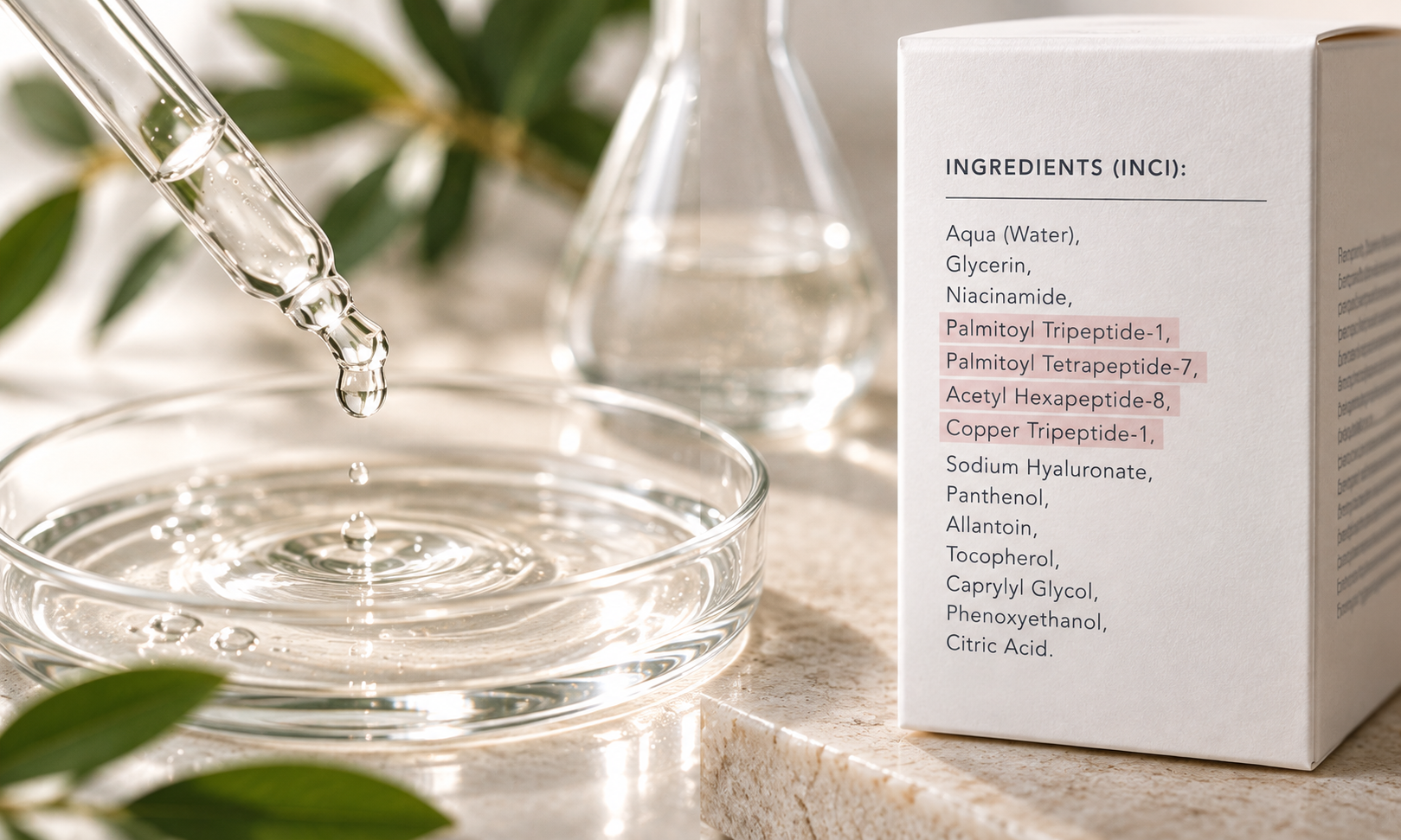
You’ve decided you want a peptide serum. You turn the bottle around, scan the ingredients and... no peptides. At least, nothing that simply says peptide in a way that makes immediate sense.

Instead, you see names like Palmitoyl Tripeptide-1, Palmitoyl Tetrapeptide-7, Acetyl Hexapeptide-8 or Copper Tripeptide-1. At first glance, it looks like chemistry homework. In reality, peptide INCI names are much easier to understand once you know what to look for.
That’s the useful part, because “contains peptides” doesn’t tell you very much. Which peptides? What are they there to do? Are they the same peptides you’ve heard called Matrixyl or Argireline? And why do some of them have numbers at the end?
Let’s decode it properly.
Peptides are short chains of amino acids. Amino acids are the building blocks used to make proteins, including proteins such as collagen that are important to skin structure. In very simple terms, you can think of it like this: Amino acids → peptides → proteins
Different peptides have different structures, and that matters because different structures serve different cosmetic purposes. That’s why “peptide” is not one single ingredient.
Before reading a peptide label, it also helps to understand what INCI means.
INCI stands for International Nomenclature of Cosmetic Ingredients. It’s the standardised naming system used on cosmetic ingredient lists, which is why a formula won’t simply say “water, vitamin B3, moisturiser, peptide complex.” Instead, you’ll see names such as Aqua, Niacinamide, Glycerin, Palmitoyl Tripeptide-1 and so on.
Once you know the pattern, peptides become much easier to spot. Look for words such as dipeptide, tripeptide, tetrapeptide, pentapeptide, hexapeptide, heptapeptide, oligopeptide or simply peptide.
The prefix often tells you how many amino acids are in the chain.
| INCI term | What it means |
|---|---|
| Dipeptide | 2 amino acids |
| Tripeptide | 3 amino acids |
| Tetrapeptide | 4 amino acids |
| Pentapeptide | 5 amino acids |
| Hexapeptide | 6 amino acids |
| Heptapeptide | 7 amino acids |
So, Tripeptide-1 is a three-amino-acid peptide, while Hexapeptide-8 contains six.
What that does not mean is that a hexapeptide is automatically better than a tripeptide. A longer chain is not a quality rating. The amino-acid sequence, structure, delivery and formulation matter far more.
The number at the end causes confusion too. The “1” in Tripeptide-1 is not 1%. The “8” in Acetyl Hexapeptide-8 is not 8%, and Palmitoyl Tetrapeptide-7 is not seven times stronger than another tetrapeptide. Those numbers are simply part of the ingredient’s standardised identity.
Then there’s another word you’ll see often: palmitoyl.
Names such as Palmitoyl Tripeptide-1, Palmitoyl Tetrapeptide-7 and Palmitoyl Pentapeptide-4 all contain it. In simple terms, a palmitoyl group is a lipid-related component attached to the peptide. This can change the molecule’s properties and may help improve its compatibility with the skin and with cosmetic delivery systems. So although the name looks more complicated, the extra word is there for a reason.
Some of the most common peptide names are worth recognising because they appear again and again in anti-ageing skincare.
Palmitoyl Tripeptide-1 is one of the better-known signal peptides used in formulas targeting smoother, firmer-looking skin and visible signs of ageing. It’s frequently paired with Palmitoyl Tetrapeptide-7, another peptide commonly found in products designed for fine lines, wrinkles and mature skin. If you see those two together, there’s a good chance you’re looking at a formula associated with Matrixyl 3000™.
And this is where trade names create another layer of confusion.
A product may advertise Matrixyl™ on the front of the box, but you may not find the word Matrixyl anywhere in the INCI list. That’s because Matrixyl is a trade name, not necessarily the official ingredient name shown on the label. For example, Matrixyl 3000™ is associated with Palmitoyl Tripeptide-1 + Palmitoyl Tetrapeptide-7.
The same thing happens with Argireline®. You may know the marketing name, but the INCI you’re looking for is Acetyl Hexapeptide-8. Acetyl Hexapeptide-8 is often used in products targeting expression lines. It sometimes gets described as “Botox in a bottle,” which is a good example of skincare marketing getting carried away. A topical cosmetic peptide is not equivalent to botulinum toxin injections. It can still be an interesting anti-ageing ingredient without pretending to be a medical procedure.

Another peptide worth knowing is Copper Tripeptide-1, often associated with GHK-Cu. This copper-binding peptide is widely used in formulas focused on skin recovery, firmness and overall skin quality. Copper-containing formulas can sometimes have a blue or blue-green tone, which is not necessarily added colouring.
You may also come across Palmitoyl Pentapeptide-4, an established anti-ageing peptide associated with smoother-looking skin and wrinkles, as well as Palmitoyl Tripeptide-38, commonly linked with Matrixyl Synthe’6™ and used in formulas targeting wrinkles, texture and firmness.
Eye creams often contain different peptide names again. Acetyl Tetrapeptide-5 is commonly found in products formulated for puffiness and tired-looking skin around the eyes, while Acetyl Tetrapeptide-2 appears in formulas aimed at skin tone and firmness.
Here’s a simple cheat sheet worth keeping:
| Peptide INCI name | Commonly associated with | Often used in skincare for |
|---|---|---|
| Palmitoyl Tripeptide-1 | Matrixyl 3000 complex | Fine lines, firmness, ageing skin |
| Palmitoyl Tetrapeptide-7 | Matrixyl 3000 complex | Wrinkles, mature skin |
| Palmitoyl Pentapeptide-4 | Matrixyl | Fine lines and wrinkles |
| Palmitoyl Tripeptide-38 | Matrixyl Synthe'6 | Wrinkles, texture, firmness |
| Acetyl Hexapeptide-8 | Argireline | Expression lines |
| Copper Tripeptide-1 | GHK-Cu | Skin recovery, firmness, ageing |
| Palmitoyl Tripeptide-5 | Various peptide technologies | Firmer, smoother-looking skin |
| Acetyl Tetrapeptide-5 | Often used in eye formulas | Puffiness, tired-looking eye area |
| Acetyl Tetrapeptide-2 | Firming peptide | Tone and firmness |
You may also see the word oligopeptide on an ingredient list. This generally refers to a short chain of amino acids rather than giving the exact chain length in the prefix. Oligopeptide terminology often appears in more advanced or growth-factor-style cosmetic formulations, so it’s worth reading the manufacturer’s explanation rather than guessing from the name alone.
Another source of confusion is the idea that all peptides are anti-ageing. They’re not.
“Peptide” describes a structural category. Different peptides can be designed for different cosmetic functions. Some are often described as signal peptides, some as carrier peptides, others as neurotransmitter-influencing peptides, and some are studied in relation to particular enzymes or biological pathways.
Those categories are helpful, but real cosmetic science is more complicated than four tidy boxes. A peptide’s effect depends on its structure, concentration, stability and the formula around it. This is also why a product boasting “12 peptides” is not automatically better than one containing two or three.
Skincare isn’t a numbers game. One well-selected peptide used at an appropriate concentration in a well-designed formula may be more meaningful than a long ingredient list created mostly for marketing impact.
The same applies to ingredient order.
People often scan an INCI list, see a peptide near the bottom and assume there’s hardly any in the product. That can be misleading. Peptides are often used at relatively low levels, and many arrive as part of pre-formulated raw-material complexes containing solvents, humectants or stabilising ingredients. So seeing glycerin or propanediol before the peptide doesn’t mean the formula is poor.
In fact, glycerin is an excellent humectant, and a good peptide serum should usually do more than simply contain peptides. Hydration, texture and barrier support all matter too.
That brings us to another common misunderstanding: peptides and collagen are not the same thing.
Collagen is a large structural protein. Peptides are much smaller chains of amino acids. A product containing Hydrolyzed Collagen is not automatically the same as a peptide serum containing ingredients such as Palmitoyl Tripeptide-1 or Copper Tripeptide-1.
The term collagen peptides adds another layer of confusion because it’s widely used in supplements. Those are generally produced by breaking collagen down into smaller peptide fragments. That’s different from the specific synthetic or biomimetic peptides used in many cosmetic formulas.
So when a product says it contains peptides, asking which ones? is still the smarter question. You may also wonder whether peptides can be used with other actives.
In most modern skincare routines, peptides fit in quite comfortably. They can generally be used alongside retinol or retinal, and many people simply separate the steps for convenience: peptides in the morning, retinoids in the evening. They can also be paired with hyaluronic acid, which supports hydration, and modern formulations can often combine peptides with vitamin C too.
The old blanket rule that peptides and vitamin C should never meet is far too simplistic. As always, the complete formulas matter more than internet ingredient myths. Eye creams are another place where reading the INCI becomes especially useful. Instead of buying something because the box says “advanced peptide eye technology,” look for specific names such as Palmitoyl Tripeptide-1, Palmitoyl Tetrapeptide-7, Acetyl Tetrapeptide-5 or Acetyl Hexapeptide-8.
Then look at the rest of the formula. Does it contain glycerin? Hyaluronic acid? Emollients? Antioxidants? Soothing ingredients? Fine lines around the eyes can look more obvious when skin is dehydrated, so sometimes the less glamorous supporting ingredients are doing more than people realise.
Peptides also fit naturally into more traditional skincare systems, including Dead Sea mineral skincare. You don’t need to choose between modern actives and mineral-based formulations. The two can complement each other. A formula may combine peptides with Dead Sea minerals, hyaluronic acid, botanical extracts, antioxidants and moisturising ingredients. Each part has a different role.
At Jericho Skincare Australia, peptide-containing products appear across several anti-ageing and eye-care ranges alongside Dead Sea mineral skincare, so reading the INCI is especially useful. Sometimes the most interesting part of a formula is hiding in tiny print on the back.

So next time you pick up a serum, moisturiser or eye cream marketed as a peptide product, ignore the front for a moment. Turn it around. Scan for words like: tripeptide, tetrapeptide, pentapeptide, hexapeptide, copper tripeptide. Then identify which ones are there. Is it Palmitoyl Tripeptide-1? Copper Tripeptide-1? Acetyl Hexapeptide-8?
Once you recognise the names, you can compare products much more intelligently.
Then look beyond the peptide. What else is in the formula?
Are there humectants? Antioxidants? Ceramides? Niacinamide? Hyaluronic acid? Natural oils? Minerals? Finally, ask the question that matters more than the number of trendy ingredients on the box: Does this formulation actually make sense for my skin and what I’m trying to achieve?
That’s the point where reading INCI stops being intimidating and starts becoming useful.
Frequently Asked Questions
How are peptides listed in skincare ingredients?
Peptides usually appear under their official INCI names, such as Palmitoyl Tripeptide-1, Copper Tripeptide-1, Palmitoyl Tetrapeptide-7 or Acetyl Hexapeptide-8. Trade names such as Matrixyl or Argireline may not appear in the ingredient list.
How can I tell if my skincare contains peptides?
Look for terms such as peptide, dipeptide, tripeptide, tetrapeptide, pentapeptide and hexapeptide in the INCI list.
What is Matrixyl called in an ingredient list?
Matrixyl is a trade name used for several peptide technologies. Matrixyl 3000, for example, is associated with Palmitoyl Tripeptide-1 and Palmitoyl Tetrapeptide-7.
What is Argireline called in INCI?
Argireline is associated with Acetyl Hexapeptide-8.
What is copper peptide called on an ingredient list?
One of the best-known copper peptides is Copper Tripeptide-1, commonly associated with GHK-Cu.
What does the number in a peptide name mean?
The final number is part of the ingredient’s INCI identity. It does not tell you the percentage, strength or concentration.
Is a hexapeptide stronger than a tripeptide?
Not necessarily. The prefix tells you how many amino acids are in the peptide chain, not how effective the ingredient is.
-
Posted in
Peptides