Skinimalism: How to Build a Simple Skincare Routine That Actually Works
Open your bathroom cabinet. How many skincare products are sitting in there right now?
A cleanser. Two moisturisers. Three serums. An exfoliating toner. Vitamin C. Retinol. Hyaluronic acid. Something with peptides. A face oil you bought six months ago. And probably at least one product you're not entirely sure what it does.
If that sounds familiar, skinimalism might be exactly what your skincare routine needs.
Skinimalism is essentially the idea that good skincare doesn't have to mean more skincare. Instead of layering product after product and chasing every new trending ingredient, you build a simple skincare routine around a few well-chosen products that actually have a purpose.

And no, it doesn't mean giving up serums, masks, exfoliation or anti-ageing skincare.
It means knowing why you're using them.
For most people, the foundations are surprisingly straightforward:
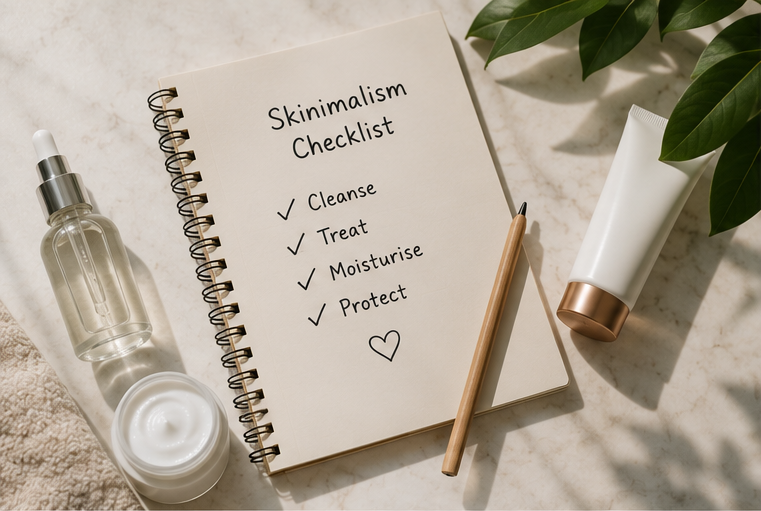
Cleanse. Moisturise. Protect. Then add targeted treatments only where they genuinely make sense.
Let's simplify that overflowing bathroom shelf.
What Is Skinimalism?
Skinimalism is a minimalist approach to skincare that focuses on using fewer, carefully selected products rather than building an unnecessarily complicated multi-step routine.
Think of it as the opposite of the 10-, 12- or 15-step skincare routines that have dominated beauty conversations over the years. The goal isn't to own as little skincare as humanly possible. It's to remove the unnecessary overlap.
Instead of:
Cleanser → toner → essence → exfoliating toner → hyaluronic serum → niacinamide serum → peptide serum → face oil → moisturiser...
...you might discover that your skin is perfectly happy with:
Cleanser → targeted serum → moisturiser → sunscreen.
Much easier. And much easier to stick with.
Does a Simple Skincare Routine Actually Work?
It absolutely can. In fact, the American Academy of Dermatology recommends a simple three-step approach as the foundation of effective skincare: cleanse, moisturise and protect the skin from the sun. It also warns that using too many products—particularly multiple anti-ageing products—can irritate the skin and make signs of ageing more noticeable.
That's an important point. A skincare routine doesn't become better simply because it becomes longer. The real question is: Does every product you're using have a job?
If it doesn't, you probably don't need it.
The Simple Skincare Routine
If you're starting from scratch—or resetting a routine that's become far too complicated—this is a great foundation.
Morning
1. Cleanse > 2. Targeted serum (optional) > 3. Moisturise > 4. Sunscreen
Evening
1. Cleanse > 2. Targeted treatment (optional) > 3. Moisturise
That's your core routine. Everything else is optional. And that little word "optional" can save you a surprising amount of money.
Step 1: Cleanse Without Trying to Strip Your Skin
Cleansing has one fairly straightforward job: Remove what shouldn't still be sitting on your skin. That includes things such as:
- Makeup
- Sunscreen
- Excess oil
- Sweat
- Everyday dirt and debris
What your cleanser doesn't need to do is leave your face feeling squeaky, tight and completely stripped. That ultra-clean sensation can actually be a warning sign that your cleanser is too harsh for your skin. After cleansing, your face should simply feel clean and comfortable.
How often should you cleanse?
For many people, cleansing in the evening is particularly important because it removes sunscreen, makeup, excess oil and debris accumulated throughout the day. Whether you also need a thorough cleanse every morning depends on your skin and the products you use. Oily skin may appreciate morning cleansing. Very dry or sensitive skin may prefer something gentler.
Skinimalism isn't about following rigid rules. It's about paying attention to your skin.
Step 2: Choose One Targeted Serum - Not Five
This is where skincare routines tend to get out of control. You start with one serum. Then somebody tells you about vitamin C. Then hyaluronic acid. Then peptides. Then niacinamide. Then retinol.
And suddenly your face has a more complicated schedule than you do.
Instead, identify your main skin concern.
If your priority is dehydration:
Look for hydrating ingredients such as hyaluronic acid and glycerin.
If your priority is visible signs of ageing:
Consider ingredients such as peptides or retinol, depending on your skin, goals and tolerance.
If your priority is brightness and uneven-looking skin tone:
Vitamin C or another targeted brightening formula may make sense.
If your skin feels sensitive or overwhelmed:
You might not need a targeted serum at all for a while.
And that's completely fine. A serum should solve a problem. It shouldn't exist in your routine simply because skincare marketing convinced you that everybody needs one.
Step 3: Don't Underestimate Your Moisturiser
Moisturiser isn't the boring product you use after the "important" serums. It is important skincare.

A good moisturiser helps maintain hydration and supports the skin barrier—the outermost part of the skin that helps reduce water loss and protect against the external environment. And yes: oily skin needs moisturising too. The texture simply needs to suit your skin.
Dry skin
You may prefer a richer cream containing moisturising and emollient ingredients.
Oily or combination skin
A lighter cream, lotion or cream-gel may feel more comfortable.
Mature skin
Look for formulas that combine hydration with ingredients targeting the appearance of fine lines, firmness and elasticity.
Sensitive skin
Keep things simple and pay attention to fragrance and any ingredients you already know your skin dislikes.
At Jericho Skincare Australia, you'll find Dead Sea mineral moisturisers in different textures and ranges, making it easier to choose based on how your skin actually feels rather than following a one-size-fits-all routine.
Step 4: Sunscreen Is the Step You Shouldn't Skip
You can simplify a lot of things in skincare. Daily sun protection isn't one I'd recommend removing.
Australia has some of the highest levels of UV exposure in the world, and Cancer Council Australia recommends sunscreen as part of sun protection when the UV level is forecast to reach 3 or above.
UV exposure contributes to:
- Premature skin ageing
- Uneven pigmentation
- Changes in skin texture
- Skin cancer risk
So if you're spending money on anti-ageing serums while regularly forgetting sun protection, your priorities may need rearranging. Protect first. Correct second.
How Many Skincare Products Do You Actually Need?
There's no universal number. But you probably need fewer than social media would have you believe. For someone without a specific skin concern, the essentials can genuinely be:
Morning
Moisturiser + sunscreen with cleansing as appropriate for your skin.
Evening
Cleanser + moisturiser
That's a completely legitimate skincare routine.
If you have specific concerns, you can build from there.
For example:
Cleanser + vitamin C serum + moisturiser + sunscreen
or
Cleanser + peptide serum + moisturiser
or
Cleanser + retinol + moisturiser
The key is that you're adding products because they address something, not because you're trying to reach an imaginary minimum number of skincare steps.
But What About Toner?
You can use one. You just don't necessarily need one. Modern cleansers don't automatically require a toner to "restore" the skin afterwards. Some toners contain genuinely useful hydrating or active ingredients, so they can serve a purpose. Others simply add another step.
Ask yourself: What is my toner doing that another product in my routine isn't already doing? If you have a good answer, keep it.
If you don't... There's your first candidate for skinimalism.
Do You Need an Eye Cream?
Another controversial one. An eye cream isn't compulsory. However, the skin around the eyes has different needs and some people prefer using a product specifically formulated for that delicate area. An eye cream can make sense if you're targeting concerns such as:
- Dryness around the eyes
- Fine lines
- Puffiness
- Loss of firmness
- Tired-looking skin
So under skinimalism, eye cream isn't automatically eliminated. It simply needs to earn its place. If your regular moisturiser works beautifully around your eyes and you're happy with the results, that's fine.
If you want more targeted care, an eye cream can be a worthwhile addition.
What About Exfoliation?
This is another area where more is definitely not always better. Exfoliation can help remove dead surface skin cells and improve the appearance of:
- Dullness
- Rough texture
- Congestion
- Uneven-looking skin
But your face doesn't necessarily need exfoliating every day. Particularly if you're already using ingredients such as:
- Retinol
- Glycolic acid
- Lactic acid
- Salicylic acid
Adding frequent scrubs or peels on top can quickly turn a productive routine into an irritating one. Skinimalism encourages you to treat exfoliation as a treatment step, not an automatic daily obligation.
Can Face Masks Fit Into a Skinimalist Routine?
Absolutely. Minimalist skincare doesn't have to be joyless. A Dead Sea mud mask, hydrating mask or mineral treatment can still have a place in your weekly routine. The difference is that you're not piling everything onto your face at once. You might have:
Daily essentials: cleanser + serum + moisturiser + sunscreen
and
Weekly extras: exfoliation + mask as needed
That's still a simple routine. It's just a routine with a little personality.
Where Do Dead Sea Minerals Fit Into Skinimalism?

Quite naturally, actually. One of the advantages of simplifying your routine is that you can look for well-formulated products that combine several useful skincare components rather than buying a separate bottle for every ingredient.
Dead Sea mineral skincare is available across:
- Cleansers
- Facial serums
- Moisturisers
- Eye creams
- Mud masks
- Exfoliating products
- Body creams
- Bath products
Dead Sea salts naturally contain minerals including magnesium, calcium, potassium and sodium.
Research into magnesium-rich Dead Sea salt solutions has found improvements in skin hydration and certain measures of skin barrier function under specific study conditions, although that doesn't mean every Dead Sea cosmetic will produce identical effects. That's why it's important to look beyond the words "Dead Sea minerals" on the label.
Consider the complete formulation. A moisturiser containing Dead Sea minerals plus humectants, emollients and other skincare ingredients may make sense as an everyday product. A Dead Sea mud mask may serve as an occasional treatment. A mineral serum might deliver your targeted step. You don't need all of them at the same time.
A Simple Skincare Routine for Dry Skin
Dry skin usually benefits from less stripping and more moisture.
Try:
Morning: Gentle cleanse if needed → hydrating serum → moisturiser → sunscreen
Evening: Gentle cleanser → hydrating or peptide serum → richer moisturiser
You might also introduce a nourishing facial oil if your skin enjoys it. The goal is comfort, hydration and maintaining the skin barrier. Not maximum product count.
A Simple Skincare Routine for Oily or Combination Skin
One of the biggest mistakes people with oily skin make is attacking it. Strong cleanser. Acid toner. Salicylic serum. Clay mask. No moisturiser. Then wondering why their face feels irritated.
Instead, try:
Morning: Gentle cleanser → lightweight serum if needed → lightweight moisturiser → sunscreen
Evening: Cleanser → targeted treatment for congestion if needed
→ lightweight moisturiser
You can add occasional exfoliation or a mud mask according to your skin's needs. Oily skin doesn't need punishment. It needs balance.
A Simple Skincare Routine for Mature Skin
This is where skinimalism can be particularly helpful. nti-ageing marketing often makes people feel like they need every ingredient simultaneously. You don't.
Start with:
Morning: Gentle cleanser → antioxidant or peptide serum → moisturiser → sunscreen
Evening: Cleanser → targeted anti-ageing treatment → moisturiser
Depending on your skin, that targeted treatment might include retinol, peptides or another active. You can also add an eye cream if the eye area is a priority. A simple routine used consistently is usually much more sensible than buying seven anti-ageing products and randomly rotating them.
A Simple Skincare Routine for Sensitive Skin
Sensitive skin is perhaps the best argument for skinimalism. If your skin frequently becomes:
- Red
- Tight
- Itchy
- Dry
- Uncomfortable
- Reactive
introducing lots of products makes it harder to identify what's causing the problem. Keep things uncomplicated.
Morning: Gentle cleanse if needed → moisturiser → sunscreen
Evening: Gentle cleanser → moisturiser
Once your skin is comfortable, introduce additional products one at a time. That way, if something doesn't agree with you, you actually know what it was.
How to Simplify Your Existing Skincare Routine
Ready to declutter? You don't need to throw everything in the bin. Start by putting your products into four groups.
1. Essentials
Your cleanser, moisturiser and sunscreen. These form the foundation.
2. Targeted Treatments
Products that address a genuine concern. Perhaps:
- Retinol
- Vitamin C
- Peptides
- Pigmentation serum
- Hydrating serum
Ask why each one is there.
3. Occasional Treatments
These might include:
- Facial peels
- Exfoliators
- Dead Sea mud masks
- Hydrating masks
They're useful, but they don't necessarily need to be used every day.
4. The "Why Did I Buy This?" Group
We all have one. If you don't know what the product does, don't know when to use it and can't remember the last time you reached for it... Your routine probably won't collapse without it.
The One-Concern Rule
Here's an easy way to stop your skincare routine expanding again. Choose your main concern.
For example: "My skin is dehydrated." Build around hydration.
Or: "Fine lines are my main concern." Choose one sensible anti-ageing treatment.
Or: "I'm dealing with congestion." Build a routine that addresses congestion without simultaneously attacking your skin with five exfoliants.
You can absolutely have more than one skin concern. But deciding which one matters most helps you choose products strategically rather than buying everything that promises "better skin."
Skinimalism Doesn't Mean Giving Up Good Ingredients
This is worth emphasising. Skinimalism isn't anti-retinol. It isn't anti-peptide. It isn't anti-vitamin C. And it certainly isn't anti-serum. It's anti-unnecessary.
You can have a sophisticated skincare routine with only four or five products if those products are thoughtfully chosen. In fact, that's often the sweet spot.
7 Signs Your Skincare Routine May Be Too Complicated
Your skin may be asking for a simpler routine if:
- Products that used to feel fine suddenly sting.
- Your skin constantly feels tight or dry.
- You're experiencing more redness or sensitivity.
- You're layering several exfoliating ingredients.
- You can't remember which products you're supposed to use on which days.
- Several products in your routine essentially do the same thing.
- You're buying new skincare faster than you can evaluate the old skincare.
If several of those sound familiar, simplifying isn't "giving up" on skincare. It may actually be the smarter approach.
How Long Should You Give a Simple Skincare Routine?
Longer than a week. Skincare is not instant, and constantly switching products makes it incredibly difficult to judge what is actually working. Give your routine consistency.
Observe how your skin feels. Take photographs if you're targeting visible changes.
And introduce new products gradually rather than rebuilding your entire routine every time a new ingredient starts trending.
The Biggest Skinimalism Mistakes
Mistake 1: Removing everything
Skinimalism doesn't mean washing your face with water and hoping for the best. Keep the fundamentals.
Mistake 2: Skipping moisturiser because your skin is oily
Choose a lighter texture instead.
Mistake 3: Removing sunscreen to save a step
That's not the step to remove.
Mistake 4: Keeping six serums because they're all "different"
Technically different doesn't automatically mean necessary.
Mistake 5: Changing your minimalist routine every week
Then it isn't really a routine.
Mistake 6: Assuming natural means gentle
Natural ingredients can irritate skin too. Choose products according to your skin, not marketing categories.
Frequently Asked Questions About Skinimalism
What is skinimalism?
Skinimalism is a simplified approach to skincare that focuses on a smaller number of purposeful products rather than complicated multi-step routines.
What is the simplest effective skincare routine?
For many people, a basic routine consists of cleansing, moisturising and daytime sun protection. Targeted serums or treatments can then be added according to specific skin concerns.
How many skincare products do I really need?
There is no perfect number. Rather than counting products, make sure every product has a clear purpose and that you're not unnecessarily duplicating ingredients or treatments.
Do I need a serum in my skincare routine?
Not necessarily. Serums are useful for delivering targeted ingredients, but they aren't compulsory. If your cleanser, moisturiser and sunscreen meet your needs, you don't have to add a serum simply because everyone else seems to use one.
Is a 10-step skincare routine better than a 3-step routine?
Not automatically. More products don't guarantee better results, and complicated routines can increase the likelihood of irritation or ingredient overlap.
Can I use retinol in a minimalist skincare routine?
Yes. Retinol can simply become your targeted evening treatment alongside a gentle cleanser and moisturiser. Follow the product directions and introduce it according to your skin's tolerance.
Can I use peptides in a simple skincare routine?
Absolutely. A peptide serum or peptide-containing moisturiser can be an easy way to incorporate anti-ageing skincare without creating a complicated routine.
Can I still exfoliate if I'm practising skinimalism?
Yes. Exfoliation can be treated as an occasional targeted step rather than something you automatically do every day.
Is Dead Sea skincare suitable for a simple skincare routine?
It can be. Choose products according to their complete formulation and your skin type. A Dead Sea mineral cleanser, serum, moisturiser or occasional mud treatment can easily fit into a streamlined routine without using every product at once.
Maybe Your Skin Doesn't Need More. Maybe It Needs Better.
The beauty industry is exceptionally good at creating the feeling that something is missing.
There's always another serum.
Another ingredient.
Another step.
Another product you're apparently supposed to have been using since yesterday.
But good skincare doesn't have to take 40 minutes.
It doesn't need its own spreadsheet.
And your bathroom cabinet doesn't have to resemble the skincare aisle at a department store.
Start with the basics:
Cleanse your skin.
Moisturise it.
Protect it from the sun.
Then look at what your skin genuinely needs and add targeted products accordingly.
A serum for hydration.
A peptide product for your anti-ageing routine.
Retinol if it's appropriate for your skin.
An exfoliator when you need exfoliation.
A Dead Sea mud mask when you want that deeper-cleansing ritual.
That's skinimalism.
Not less skincare simply for the sake of using less.
Less confusion. Less unnecessary layering. And a routine where every product has a reason to be there.
Explore Jericho Skincare Australia's facial skincare collection to build a routine around your skin type and concerns, from Dead Sea mineral cleansers and moisturisers to targeted serums, eye care, facial peels and masks.